19 Days Trip Everest Region Treks

Everest 3 High Passes Trek – Anticlockwise Route

Cross three of the Khumbu’s toughest passes on this 19-day anticlockwise circuit: Kongma La (5,535 m), Cho La (5,420 m) and Renjo La (5,360 m). Starting with a scenic flight to Lukla, the route links Everest Base Camp, Kala Patthar and the emerald Gokyo Lakes, with acclimatization days in Namche and Gokyo. Expect long, demanding days above 5,000 m, but views of Everest, Lhotse and Makalu make every crossing worth it.

Grade Strenuous treks involve demanding terrain, long walking days, substantial elevation changes, and potentially high mountain passes above 5,000 meters. Trekkers need excellent endurance, thorough preparation, and preferably previous high-altitude trekking experience. Weather and altitude can make these journeys especially demanding. Strenuous
Transport Lukla flights and essential airport transfers are included. Included
Max Altitude 5,554m
Meals 18 Breakfasts, 16 Lunches & 16 Dinners are included throughout the tour. Included
Best Season Spring & Autumn
Starts At Kathmandu
Ends At Kathmandu
Accommodation 2 nights at three star standard hotel in Kathmandu and 16 nights at teahouses accommodations in the mountain regions. Included

Trip Highlights

  • Three high passes in one anticlockwise loop. Cross Kongma La (5,535 m), Cho La (5,420 m) and Renjo La (5,360 m), with the route building up to the hardest days gradually.
  • Acclimatize before the hard days. A rest day in Namche with the hike to Everest View Hotel, then a stay in Chhukung with the Chhukung Ri hike (5,546 m), puts you in good shape before Kongma La. From the top you see Lhotse, Makalu, Ama Dablam and Island Peak.
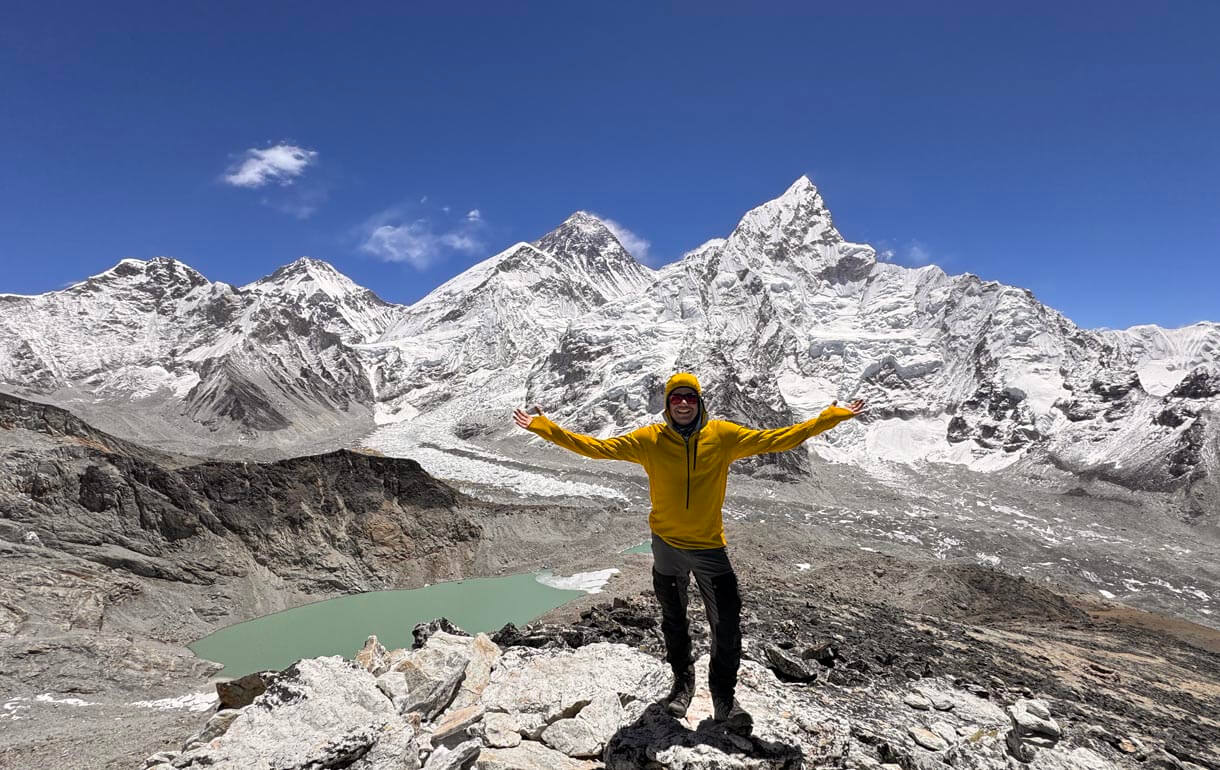
  • Everest Base Camp and Kala Patthar. Stand at EBC (5,364 m) beside the Khumbu Glacier, then climb Kala Patthar (5,545 m) for the classic close view of Everest’s face at sunrise.
  • Gokyo Lakes and Gokyo Ri. Camp beside the turquoise lakes, then climb Gokyo Ri (5,357 m) for views of Everest, Lhotse, Makalu, Cho Oyu and the Ngozumpa Glacier, Nepal’s longest glacier.
  • Quieter trails on the western side. After Renjo La, descend through Marlung and Thame, away from the busy Lukla–EBC route. Thame has a historic monastery and is the home village of Tenzing Norgay.
  • Sherpa culture along the way. Visit the Namche market, the monasteries of Tengboche and Pangboche, and Khumjung with its Hillary-founded school. You stay in family-run teahouses throughout.
  • Four of the world’s 8,000 m giants. See Everest (8,848 m), Lhotse (8,516 m), Makalu (8,485 m) and Cho Oyu (8,188 m), along with Ama Dablam, Cholatse, Taboche and Pumori.
  • Sagarmatha National Park scenery. This UNESCO World Heritage site takes you from pine and rhododendron forest to glacial moraine. Thar, musk deer and pheasants are possible sightings.

Why Book With Us

  • Experienced Local Guides with Firsthand Knowledge Trek with our knowledgeable local guides who understand the Everest region's trails, mountain conditions, Sherpa culture, and high-altitude challenges. Their local experience helps you navigate this demanding circuit with informed guidance.
  • Expertise in High-Altitude Trekking The Three High Passes route is more demanding than the standard Everest Base Camp Trek. Our trekking team understands the importance of a suitable pace, acclimatization, and careful assessment of trail and weather conditions.
  • Responsible Trekking and Safety-Focused Support From the pre-trek briefing to the high mountain passes, we emphasize preparation, regular communication, and responsible decision-making. Our guides monitor how trekkers are coping with altitude and help coordinate appropriate assistance when needed.
  • Personalized Itineraries and Private Trekking We can discuss itinerary adjustments and appropriate acclimatization time to help make your Himalayan journey more comfortable and rewarding before the booking. Due to challenging high passes trek, we organize it as a private trek.
  • Authentic Sherpa Culture and Local Connections Go beyond the mountain views to discover traditional Sherpa villages, Buddhist monasteries, local hospitality, and the culture that shapes life in the Khumbu. Our local team can help you appreciate the region beyond the usual trekking highlights.
  • Transparent Pricing and Personal Support Know what your trekking package includes before you book, with clear communication about costs, services, and possible additional expenses. Our Kathmandu-based team provides personal assistance before, during, and after your trek.

Why Three High Passes Trek in the Everest Region?

Reasons to do Everest 3 High Passes Trek

Everest Three High Passes Overview

A strenuous Everest high passes trek journey that’s challenging…but then whoever said hiking through some of the most beautiful wilderness in the world would be easy? This is a trip that requires more grit than experience…

The 3 high passes of the Khumbu is a trailblazing trek into the familiar wilderness above the treetops of the Everest region. These 3 truly gritty high passes known the world over as the Kongma La (5,535m), Cho La (5,420m) and Renjo La at (5,340m) of the better known Khumbu zone are what daredevil climbers will want to do once in a lifetime because of its sheer beauty and the formidable challenges it poses.

The venture also covers well-known trails that include EBC, the towering Kalapathar and the tranquil Gokyo valley with its emerald lakes. The cultural aspects of this trip are simply amazing as it gives you deep insights of mountain traditions and how mountain communities survive in these harsh zones, but yet reserve their warm smiles for visitors despite the biting cold.

Our journey ventures into the virgin Nangpa la valley, a sublime Sherpa village where trekkers relish the power of nature and this also covers the vibrant village of Thame which is home to one of the biggest monasteries in the Khumbu & the Himalayan views from hereabouts is said to be some of the best in the world.

Why We Recommend the Anticlockwise Route ?

On every mountain trek, the direction of a high- altitude matters. So, our anticlockwise itinerary provides enough time to acclimatize the body before crossing the highest and most demanding passes.

Before moving towards the high passes, you trek through Namche, Tengboche and Dingboche to gain high-altitude experience. Thereafter, the route connects the Khumbu Valley with Kongma La, Everest Base Camp, Gokyo, Cho La, and Renjo La before returning towards Namche Bazaar.

Everest 3 high passes trek itinerary in summary

The 19-day Everest High Passes Trek of the Khumbu is a trailblazing journey into the familiar wilderness above the treetops of the Everest region. These three genuinely gritty high passes known the world over as the Kongma La (5,535m), Cho La (5,420m), and Renjo La (5,340m) of the better-known Khumbu zone are what daredevil climbers will want to do once in a lifetime because of its sheer beauty and the formidable challenges it poses. The venture also covers well-known trails, including EBC, the towering Kalapathar, and the tranquil Gokyo Valley with emerald lakes.

The cultural aspects of this trip are remarkable as they give you deep insights into mountain traditions and how mountain communities survive in these harsh zones while retaining their warm smiles for visitors despite the biting cold. Our journey ventures into the virgin Nangpa la valley, a sublime Sherpa village where trekkers relish the power of nature. This also covers the vibrant village of Thame, which is home to one of the biggest monasteries in the Khumbu. The Himalayan views from hereabouts are said to be some of the best in the world.

Favorable Season for Everest High Passes Trek:

The best season to undertake the Everest 3 High Pass Trek is typically during the autumn months of October and November. During this time, the weather is stable, the skies are clear, and the temperatures are relatively moderate, making it ideal for trekking through the challenging high passes of Renjo La, Cho La, and Kongma La. The views of the surrounding Himalayan peaks are at their most spectacular, and the trails are generally safe and accessible, providing an unforgettable trekking experience in the Everest region.

June, July, and August are the low months to visit the Everest region as the trail remains slippery and muddy due to the monsoon. Furthermore, January and February months are typically highly cold seasons, and the trails are covered by snow. In addition, visit our trekking season information section for further details.

Check out our designated itinerary below for Everest 3 High Passes Trek or kindly send us an email and we’ll tailor-make an itinerary based on your requirements.

Everest Three High Passes Outline Itinerary 

Day Itinerary Altitude Elevation Gain/Loss Walking Duration
01 Arrival in Kathmandu airport and transfer to the hotel 1,400m/ 4,593ft – –
02 Flight to Lukla and trek to Phakding 2,846m/ 9,337ft – 2,610m/ 8,563ft -148m/-486ft 4 hours
03 Trek to Namche Bazar 3,440m/ 11,268ft +788m/+2,585ft 6 hours
04 Acclimatization Day 3,440m/ 11,268ft – 2-4 hours
05 Trek to Tengboche 3,860m/ 12,664ft +420m/+1,396ft 5 hours
06 Trek to Dingboche 4,410m/ 14,468ft +500m/+1,640ft 5 hours
07 Trek to Chhukung 4,750m/ 15,584ft +390m/+1,280ft 4 hours
08 Rest Day 4,750m/ 15,584ft – 3 hours
09 Trek to Lobuche via Kongma La Pass 4,940m/ 16,207ft +190m/+623ft 7 hours
10 Trek to Everest Base camp and return to Gorakshep 5,364m/ 17,598ft – 5,170m/ 16,962ft +194m/+636ft (to EBC) 9 hours
11 Trek to Lobuche via Kalapather 4,940m/ 16,207ft -424m/-1,391ft 8 hours
12 Trek to Dzongla 4,830m/ 15,846ft -110m/-361ft 4 hours
13 Trek to Gokyo via Chola Pass 4,800m/ 15,748ft -30m/-98ft 8 hours
14 Rest Day 4,800m/ 15,748ft – 2-3 hours
15 Trek to Marlung via Renjo La 4,210m/ 13,812ft -590m/-1,936ft 8 hours
16 Trek to Namche Bazar 3,440m/ 11,286ft -770m/-2,526ft 6 hours
17 Trek to Lukla 2,846m/ 9,337ft -640m/-2,100ft 7 hours
18 Fly Back to Kathmandu 1,400m/ 4,593ft -1,400m/-4,593ft –
19 Departure from Nepal – – –

Am I eligible for this challenging high altitude hike?

If you are a seasoned hiker and physically fit, then you are definitely eligible for this challenging high-altitude adventure. The Everest 3 High Passes Trek demands good stamina, endurance, and previous hiking experience in rugged terrain.

Since 2011, Glorious Himalaya Trekking Company has been operating this tour for hundreds of thrill-seekers, and 97% of our previous customers have successfully completed the journey. With the right preparation and determination, you too can conquer this incredible Himalayan challenge.

Our expert local mountain guides and porters are the backbone of your journey. They are always there to motivate and support you throughout the journey.

So, are you a thrill seeker and looking for a challenging high-altitude hike inside the Himalayan region of Nepal? Then, book our 19 Days Everest 3 High Passes Trek and test your physical and mental endurance along with our local Sherpa guide and porters.

We have also another Everest 3 High Passes Clockwise route Package and Everest Three Passes with Island Peak climbing package for you.

You can also check our 14 Days Everest Base Camp Trek package if you are looking a short and less challenging hike in the Everest region.

Detailed Itinerary

01 DAY

Arrival in Kathmandu airport and transfer to the hotel

Altitude 1400 m
Accommodation Hotel

Arrival in Kathmandu nepal

After your arrival at Tribhuwan International Airport in medieval and modernized Kathmandu, you will be warmly greeted by our office representative and transferred to the hotel. After check-in and some refreshments, our senior Sherpa guide will come to meet you and give you a brief orientation about Three High Passes Trek.

You can then go for a stroll down the street to get familiar with the neighborhood, have supper and go to bed. This is your first overnight in the valley of temples and cows, probably the most in the world.

02 DAY

Flight to Lukla and trek to Phakding

Flight Hours 30 Min
Altitude 2610 m
Trek Duration 4 hrs
Meals B L D
Accommodation Teahouse

Phakding

A thrilling scenic flight to Lukla and a landing on a steep mountain runway bring us to the start of our trek at the village of Lukla [2846m]. After meeting the crew, we head up the Dudh Kosi Valley on a well-marked trail and then stay overnight in Phakding. We stay overnight at an altitude of 2610m. in the local lodge.

03 DAY

Trek from Phakding to Namche Bazar

Altitude 3440 m
Trek Duration 6 hrs
Meals B L D
Accommodation Teahouse


Hillary bridge

After a good breakfast at Phakding, we set out for the mountain junction town of Namche; we cross and re-cross the river on high airy suspension bridges. Beyond Monjo is the entrance to the Sagarmatha National Park which was set up to protect and preserve the fragile mountain environment. We then take a steep hike to Namche. If the weather is clear, we get our first glimpse of Mt Everest.

Namche is the main trading village in the Khumbu and has a busy Saturday market – a meeting place for the Hindu traders from the lowlands and the Tibetan yak caravans that have crossed the glaciated Nangpa La. Namche is the gateway to the Khumbu. This is where we crash out for the night with all meals included. We stay overnight at the height of 3440m. in the lodge.

04 DAY

Hike to Hotel Everest View on Our Acclimatization Day

Altitude 3880
Trek Duration 2 hrs
Meals B L D
Accommodation Teahouse


Hike to Everest view hotel

Namche is tucked away between two ridges amidst the giant peaks of the Khumbu and has an abundance of lodges, tea shops, and souvenir shops. It is an ideal place to spend a day, acclimatizing to the new altitude before heading off towards Syangboche. To acclimatize, you visit Khunde Hospital set up by Sir Edmund Hillary, or take a one-hour walk up to the Everest View Hotel above Namche for the sunset view of Ama Dablam, Nuptse, Lhotse, and Everest.

We then go to Khumjung where we visit a school established by Hillary. We begin our hike after enjoying lunch; bypassing the route of Khimde. There are also good views from the National Park Centre and Museum just above the town. After going through our acclimatization drills, we head down to our lodge for some beers & good sleep.

05 DAY

Trek from Namche Bazaar to Tengboche

Altitude 3860 m
Trek Duration 5 hrs
Meals B L D
Accommodation Teahouse

Trek from Namche Bazaar to Tengboche Monastery

After breakfast in Namche, we start our trek towards Tengboche enjoying a superb view of Mt. Everest, Nuptse, Lhotse, Ama Dablam and close up view of Thamserku. Our trek follows on the gradual trail with few ups and downs overlooking magnificent view of the great Himalaya.

Along the way, we can spot wild lives like pheasant, musk deer, or a herd of Himalayan Thar. The trail goes gradually down up to Kyangjuma. The path eventually reaches Sanasa which is the major trail junction to Gokyo valley and Everest Base Camp.

The track then follows through the pine forests and after we cross the prayer flags festooned bridge over Dudh Kosi River, we reach Phunki Tenga, a small settlement with a couple of teahouses and a small army post amidst the alpine woods. After having a relaxed lunch at Phunki Tenga we then have a little tough climb steep up through the pine forests while before we reach Tengboche.

Tengboche is a great place for close-up views of Ama-Dablam, Nuptse, and Everest and it has the biggest Buddhist Monastery all over in the Khumbu region. Overnight stay at the lodge in Tengboche.

06 DAY

Trek from Tengboche to Dingboche

Altitude 4410 m
Trek Duration 5 hrs
Meals B L D
Accommodation Teahouse

Dingboche village

With the Mountains as a backdrop, the monastery in Tengboche looks spectacular more in the morning. We click pictures of the monastery and the sceneries around and as usual start the day journey on a merry note. We choose the upper trail for better views to visit Pangboche village and its ancient Monastery. We pass through several Chortens and Mani walls and small villages.

We enjoy lunch with fantastic close-up views of Ama-Dablam. In the afternoon, go north to Pheriche or take the eastward trail beneath the towering north face of Ama Dablam. From here onwards the walk is fairly moderate as we enter the Imja Valley.

The valley ahead will begin to open up as we approach the confluence of the Lobuche River, we descend into the river and begin the last and steepest climb of the day up to Dingboche On arrival in Dingboche, we enjoy the beautiful array of fields enclosed by stone walls to protect the barley, buckwheat, and potatoes from the cold winds and grazing animals. Overnight at a local lodge in Dingboche.

07 DAY

Trek from Dingboche to Chhukung

Altitude 4750 m
Trek Duration 4 hrs
Meals B L D
Accommodation Teahouse

Trek from Dingboche to Chhukung

Today after breakfast, our walk takes off at a cool pace with only about a 3-4 hours hike to Chhukung. The trek goes through Imja Khola valley and sublime alpine landscapes, and some stone-walled fields. On the trail, we will also have spectacular mountain views of Mt. Lhotse, Mt. Ama Dablam, and Island Peak. Imja Tse has a splendid pyramid shape with its step rock and icy south face.

Chhukung is a great place to explore the glacier and massive snow-laden mountains all around the place. Overnight at an elevation of (4,750m) where the air gets thinner. We bunk out in a local lodge.

08 DAY

Hike to Chhukung Ri

Altitude 5546 m
Trek Duration 3 hrs
Meals B L D
Accommodation Teahouse

view from Chhukung Ri

This extra day for acclimatization is good for our bodies to cope with the heights before doing the passes that begin with Kongma La (5,535m). Today, we will take a gentle hike to nearby viewpoints, such as Chhukung Ri (5,546 meters) or the trail toward Imja Tse Base Camp.

From the Chhukung Ri viewpoint (5,546m) in Nepal, we can see stunning peaks like Lhotse (8,516m), Makalu (8,485m), and Baruntse (7,129m). The view also includes Ama Dablam (6,812m) and Island Peak (6,189m), creating a breathtaking panorama. The vantage point offers a sweeping sight of the Everest region, showcasing dramatic glaciers and rugged ridges.

We can also walk around Chhukung village to get a feel for the local culture and lifestyle.

We then descend back to Chhukung. Overnight at a cozy teahouse lodge.

09 DAY

Trek from Chhukung to Lobuche via Kongma La Pass (5,535m)

Altitude 4940 m
Trek Duration 7 hrs
Meals B L D
Accommodation Teahouse

View from Kongmala Pass

We start at the break of day from Chhukung as we have to capture the highest pass of the trip today. We carry plenty of water and some snacks and a packed lunch as there are no tea shops on the way.

We enjoy the remoteness of the area and absolute nature!! We can select to go via any of the possible trails- either taking a climb over the hill northwest of Chhukung over the moraine of the Nuptse Glacier or we might walk back down the valley to Bibre and follow a high trail above the Niyang Khola.

Just after so7 hrsme walk, there are great views of Island peak-valley and the jagged ridge of Amphu Lapcha. Ascending along the east side of Niyang Khola valley, we turn west and walk through the sloppy stony trial. We enter a wide basin dotted with small frozen lakes. The trail rises over loose screed gaining the Kongma La after about five hours we leave Chhukung.

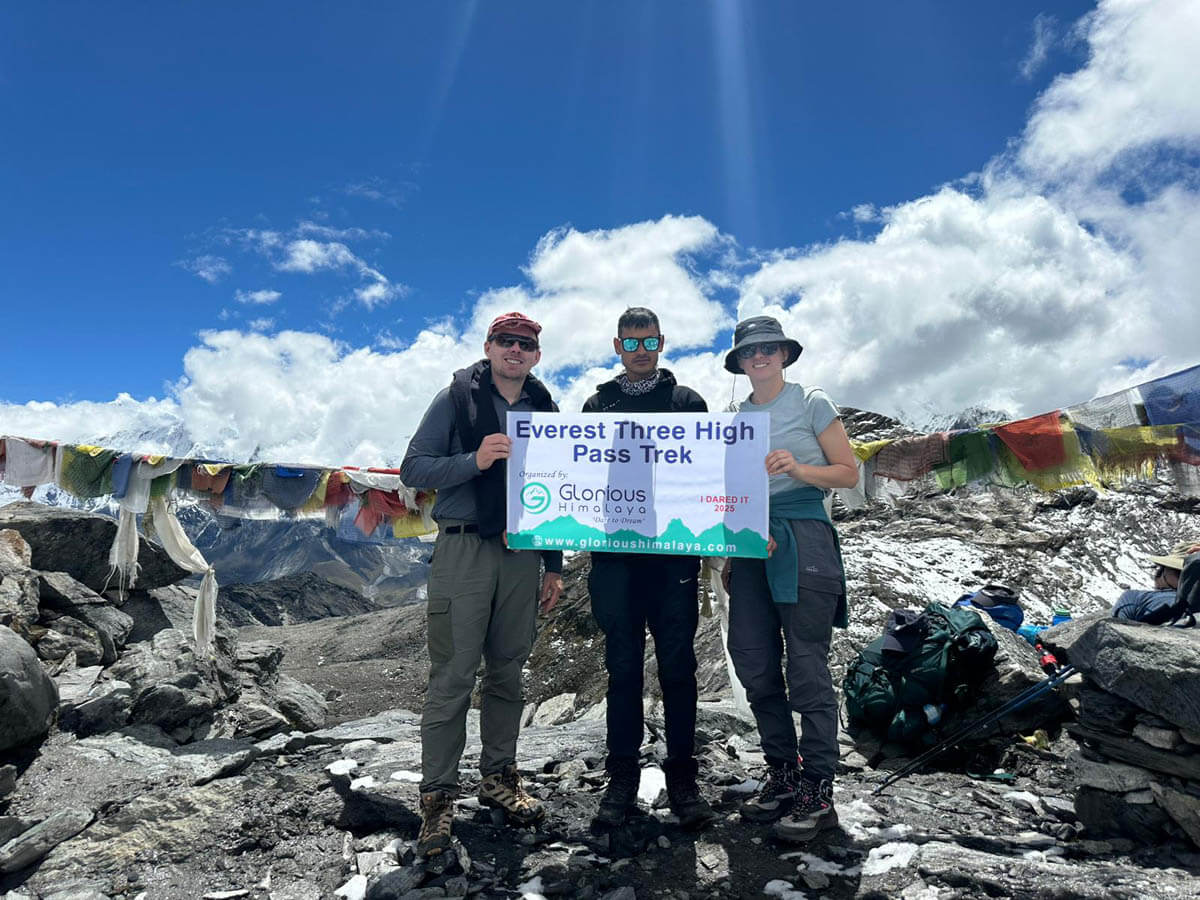
Upon reaching the top, we can see cairn wrapped in prayer flags,-marks of the pass. Behind us is the landscape of icy lakes ahead down of which is the Khumbu Glacier. The final descent is the toughest stage of the trek today, upon climbing the moraine on the far side, the trail turns north through Khumbu Glacier which culminates at Lobuche. We do an overnight in Lobuche.

10 DAY

Trek from Lobuche to Everest Base camp (5,364) and back to Gorakshep (5,170m) for overnight stay

Altitude 5170 m
Trek Duration 9 hrs
Meals B L D
Accommodation Teahouse

Trek to Everest base camp from Lobuche

Today after a steamy breakfast at our lodge, we climb through meadows and moraine stones steps to reach Gorakshep, by either climbing to Kalapathar or continuing heading to Everest base camp.

We suggest that you make a beeline for the Everest base camp. By the way, from Everest base camp we do not see Mount Everest. However, from Kalapathar, we get to see the entire south face of Mt. Everest and well-known peaks nearby; this also includes great sights of the skyline of the Tibet plateau. Overnight at the height of (5,364) in our lodge.

11 DAY

Hike from Gorakshep to Kalapather (5,545m) and trek down to Lobuche

Altitude 4940 m
Trek Duration 8 hrs
Meals B L D
Accommodation Teahouse

HIke to Kalapatthar from Gorakshep


Today early in the morning we begin our trek to get remarkable views of the sunshine gleaming on the face of Everest from Kalapathar. We are surrounded by darkness and cold temperatures of approximately 10 to15 degrees Celsius in the morning. It is a testing hike to Kalapather because of the high altitude and shivering cold.

On reaching the peak of Kalapather, we will have unbelievable views of the mountains that you will see only once in your lifetime. We snap as many beautiful pictures from the top of Kalapathar to take home with us the memory of king Everest. We return to the Lobuche for an overnight stay.

12 DAY

Trek from Lobuche to Dzongla

Altitude 4830 m
Trek Duration 4 hrs
Meals B L D
Accommodation Teahouse

After breakfast, we will be heading towards Dzongla. The trek is about 3 to 4 hours. The route goes beside the river bed off the stream. The trail heads in the southeastern side which provides us a lovely view of the towering heights of Ama Dablam and Kangtega-Thamserku. Similarly, Taboche looms is just a few steps ahead.

The ancient village, Pheriche village is also clearly visible during our trek. We will go through a mound in Chukpi Lhara which will bid goodbye with fresh memories. Chola Lake spread below Mt Cholaste is a view to observe on our route.

The lakes will give us a fresh view until we descend a basin. Then we have to climb up a spur and then have to descend a steeply way down to another broad basin. Then after an hour’s walk, we reach Dzongla. Meanwhile, we will have to cross a bridge in this an hour walk. We will stay overnight in Dzongla at local guest houses.


13 DAY

Trek from Dzongla to Gokyo via Cho La Pass (5,420m)

Altitude 4800 m
Trek Duration 8 hrs
Meals B L D
Accommodation Teahouse

Trek from Dzongla to Gokyo via Chola Pass

Dzongla-Gokyo is our next trek route which is about a 7-8 hours walk. After breakfast, we will start our trek from Dzongla. Just after we step out of the hotel we can have a splendid view of Cholatse. We have to head towards the western side of Dzongla. The trip today is a little harder than earlier. The path descends; we will go beside the stream coated with ices in some places.

About after an hour, we will reach the top of the basin. From there we can have the enchanting view of Chola Lake and the Ama Dablam which appears over a range of mountains in the south and Cholaste soars on the west. The journey from here seems to be a little difficult as climbing the incline which is steeply made more difficult by boulders and may we have to scramble.

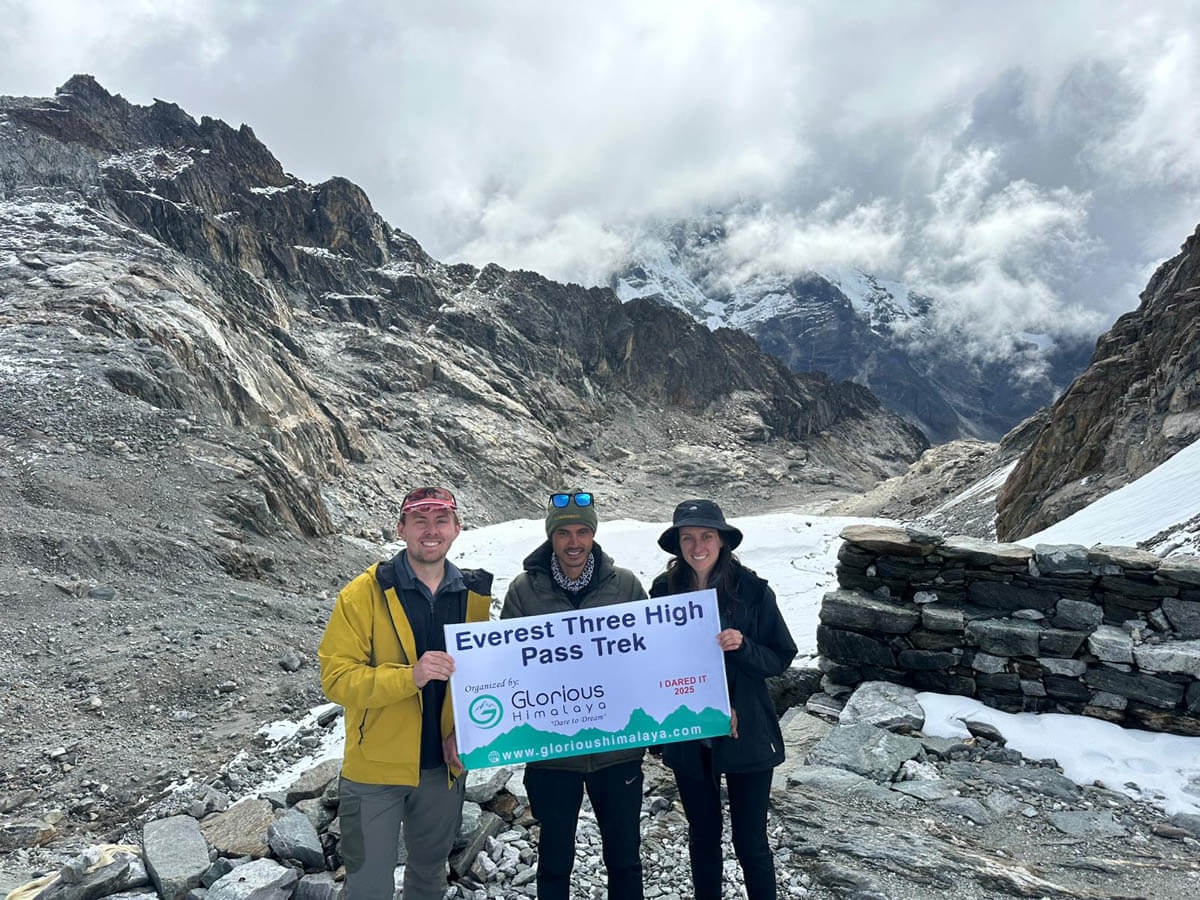
We may have to bear a little risk as the rocks can be glazed by ice. After we reach the top we can see prayer flags, strung across cairns, flapping in the strong wind. The exciting view will take your breath out. The path from here is a little easy as we just have to descend but it can be found dangerous if rocks are gazed by the ice. So we need to be careful.

Then we reach Thangnak, and as we pass the village we will be welcomed by shiny Mountain View. After a short walk, we will be at the edge of the Ngozumpa glacier. Then after the other side of the glacier, we can have a view of beautiful Gokyo Lake. On the edge of Gokyo Lake, Gokyo village is situated. It is our final destination where we stay for a night.

14 DAY

Hike to Gokyo Ri

Altitude 5357 m
Trek Duration 3-4 hrs
Meals B L D
Accommodation Teahouse

gokyo ri

On the day, we will take a rest in the Gokyo village and have a view of the enchanting sites of Gokyo village. If the day is favorable then we can climb Gokyo Ri and enjoy the view of the clear Everest Region. The Gokyo region not only provides you a view of the Gokyo peak but also adds an opportunity to view a series of six lakes. You can also see Thonak Thso Lake (fourth lake) and Ngozuma Thso lake (fifth lake).

The fourth lake of this series has high cliffs and peaks rising above the lake just about 3 km north. We can have a view of the turquoise-colored water of the lake. Moreover, we can climb on the hill and get an amazing view of Mt. Cho-Oyu, Mt. Gyachung Kang, Mt. Everest, Mt. Lhotse, Mt. Nuptse, and Mt. Makalu. Cho-Oyu base camp is situated beyond the fifth lake, from where we can have a closer view of Mt. Cho Oyu and Gyachung Kang.

Cho-Oyu base camp and the biggest glacier of the world- the Ngazumpa Glacier is the view to observe from the northern part of the fifth lake. If possible we may even head to the sixth lake too. Then we return to Gokyo village and spend overnight at the lodge.

15 DAY

Trek from Gokyo to Marlung via Renjo La (5,360m)

Altitude 4210 m
Trek Duration 8 hrs
Meals B L D
Accommodation Teahouse

Trek to Marlung via Renjola pass

After a rest day and some sightseeing in Gokyo, we trek to Marlung via Renjo La Pass. We need to set off at a steady pace, as there is nowhere to stay at Renjo La. Leaving the Gokyo Valley, we follow the Renjo La trail past Dudh Pokhari. After about 3 hours of walking, we reach Renjo La, where we are rewarded with views of Mt. Everest (8,848 m), the highest peak in the world, along with Mt. Lhotse (8,516 m), Cholatse (6,440 m) and Taboche (6,542 m).

The view here is similar to the one from Gokyo Ri, with the third Gokyo Lake and Gokyo village lying below, beside the Ngozumpa Glacier. Continuing on, the trail descends a stone staircase, and we need to scramble in places to reach the south bank of a small, sparkling lake called Angladumba Tsho. There may be ice on the trail as we descend. Along the way we also pass Relama Tsho and Renjo Lake. We then walk down a narrow valley to Lumde, where a lodge may be available, though it is often closed. From Lumde, it takes about an hour to reach Marlung, on the east bank of the Bhote Koshi. Overnight in Marlung.

16 DAY

Trek from Marlung to Namche Bazar

Altitude 3440 m
Trek Duration 6 hrs
Meals B L D
Accommodation Teahouse

Trek to Namche from Marlung

After spending the night at Marlung, we descend to Namche Bazaar, starting early in the morning. We follow the route once used by Tibetan traders. We cross the Bhote Koshi and descend to Taranga. The path then goes through the valley of the Langmoche Khola, a stream that drains from the glacial lake Dig Tsho. This lake burst in 1985, causing floods that affected the Dudh Koshi valley and Thame.

Thame is a beautiful village with a few lodges. From here we can also get eye-catching views of mountains such as Thamserku, Kangtega and Kusum Kanguru. A famous gompa stands on the western hill, a short walk past some fields. It is believed to have been established about 325 years ago. The gompa houses three large images of Chenrezig (Avalokiteshvara), Guru Rinpoche and Buddha Shakyamuni. If you visit in May, you can enjoy the colorful Mani Rimdu festival, which features mask dances.

Moving on, we cross a bridge and reach Samde, then descend again to Thamo village. Here we see Khari Gompa, a nunnery that is home to nuns and monks. Leaving the village behind, we pass the hydroelectric power station built with Austrian help, said to be the world’s highest. After a short walk, we come to Phurte, where the Lhaudo Monastery is located. It is run by the Kopan Monastery of Boudhanath in Kathmandu and is popular among Western visitors for Buddhist study and meditation. Finally, we reach Namche Bazaar, passing gompas, colorful prayer flags and mani stones along the way. Overnight in Namche Bazaar.

17 DAY

Trek from Namche Bazaar to Lukla

Altitude 2846 m
Trek Duration 7 hrs
Meals B L D
Accommodation Teahouse

Trek to Lukla from Namche Bazaar

Following the morning breakfast, we continue our trek to Lukla along the Dudh Koshi River. The trail goes steeply downward with rocky terrain. Even though we are walking the same route, we feel completely different than before. We pass through the rhododendron, pine, and oaks forest and several snow-covered peaks. Overnight at local lodge.


18 DAY

Fly back to Kathmandu

Flight Hours 30 Min
Altitude 1400 m
Meals B
Accommodation Hotel

Fly back to Kathmandu from Lukla

Usually, a flight from Lukla to Kathmandu is scheduled in the early morning. We take a scenic flight from Lukla to Kathmandu for about thirty minutes. And then transfer to your hotel for refreshment. But sometimes the flight can be delayed or canceled in the mountain regions due to bad weather and other unprecedented reasons that are beyond our control.


19 DAY

Departure from Nepal

Meals Breakfast

Today, we will drop you to the international airport three hours before our scheduled flight to catch to fly back to your home and pray for your Safe journey.

Trip Includes

Transportations:

  • International airport pick-up and drop-off by private vehicles.
  • Domestic flights (Kathmandu/Ramechhap–Lukla–Ramechhap/Kathmandu).
  • Domestic airport transfers by private vehicle in Kathmandu.
  • Manthali airport transfers on sharing basis in Ramechhap.

Meals:

  • Meals on full board during the trek in the mountain region.
  • Seasonal fresh fruits every evening after dinner as desserts.
  • Buffet breakfasts in Kathmandu hotel.
  • Farewell dinner in Kathmandu after the trek.

Accommodations:

  • 2 nights of 3-star standard hotel accommodation in Kathmandu city inclusive breakfast.
  • 16 nights of twin sharing local lodges accommodations while on the trek.

Trek permits:

All the essential trekking permits for the trek.

  • Sagarmatha National Park Entry Permit
  • Pasang Lhamu Rural Municipality Entry permit.

Local Staffs:

  • Highly experienced and government-certified guide for the trek.

Complementary Service: 

  • Emergency helicopter arrangement incase of any physical or natural hazards on trekking. (You should have travel insurance in this case)
  • Rain protection duffel bag and sleeping bag to use for the trek. (provided on request)
  • First aid medical kits with oximeters to measure your pulse and oxygen level while on the trek.
  • Trip achievement certificate after the successful trip completion.
  • Pre-meeting at Kathmandu before the trek.

Government Taxes:

  • All the government taxes and company service charge

Trip Exclude

  • International airfares and Nepal entry visa.
  • Lunch and dinner in Kathmandu hotel stay.
  • Extra hotel nights in Lukla and Kathmandu if other than the itinerary.
  • Your personal expenses such as the use of WIFI, hot shower and charging while on the trek.
  • Porters are available at an extra cost.
  • Gratitude to the guides and porter.
  • Excess baggage of more than 15 kg for Lukla flight.

Kindly Note:

If you returned Kathmandu earlier than the scheduled itinerary due to your own problem or interest, no refunds will be issued for pre-arranged services in the mountains, such as flights, meals, accommodation, and staff salaries. And you will be responsible for your hotel accommodations, meals and transports expenses in Kathmandu. 


Available Dates For 2026 & 2027

Reserve your date shortly

Our fixed departures for the Everest 3 High Passes Trek welcome solo travelers and small groups who’d like to share the trail with others. Choose your date below to reserve your place.

Guaranteed departure: If no other travelers join your chosen date, your trek will still go ahead as planned, even if you’re the only one in the group.

Trip Route Map

Everest 3 High Passes Trek Altitude Chart

Altitude in:

Everest 3 High Passes Trek – Anticlockwise Route Packing Lists

Download Checklist

The Everest Three High Passes Trek is longer and more challenging than the standard Everest Base Camp Trek. With several days spent at high altitudes and crossings of Kongma La, Cho La, and Renjo La passes, you’ll need to pack carefully and bring a few extra clothing items to stay warm and comfortable. Follow our packing checklist to ensure you have all the essentials while keeping your duffel bag within the porter weight limit.

Head

  • Sun Hat / Cap: Wide-brimmed for sun protection.

  • Beanie / Warm Hat: Essential for cold mornings/nights.

  • Buff / Neck Gaiter: For dust, wind, and sun protection.

  • Sunglasses: Category 3 or 4 UV protection (essential for high altitude).

  • Headlamp: With extra batteries (for early starts/night treks).

  • Sunscreen & Lip Balm: SPF 50+ (must-have).

  • Face Mask / Balaclava: For extreme cold or dusty trails.

Upper Body

  • Base Layer (Thermal): Moisture-wicking (Merino wool or synthetic). x2-3

  • Fleece Jacket / Mid-layer: For warmth.

  • Down Jacket: Insulated, lightweight (essential for high altitude).

  • Raincoat/Poncho: Waterproof and windproof.

  • Trekking T-shirts: Quick-dry, breathable. x3-4

  • Long-sleeve Sun Shirt: For hot days.

  • Gloves: Insulated trekking gloves

Lower Body

  • Trekking Pants: Convertible (zip-off) or lightweight. x2

  • Fleece / Thermal Pants: For layering under trekking pants.

  • Rain Pants / Over-trousers: Waterproof.

  • Shorts: For lower altitudes / warm days.

  • Underwear: Moisture-wicking, quick-dry. x3-4

  • Warm trekking trousers: For higher altitudes

Footwear

  • Trekking Boots: Mid to high-cut, waterproof, broken-in.

  • Camp Shoes/ Sandals /Flipflop: For relaxing in teahouses after trekking.

  • Gaiters: To keep snow/rocks out of boots.

  • Microspikes / Crampons: Useful for icy trails (seasonal).

  • Trekking Socks: 3–5 pairs of moisture-wicking socks to keep your feet comfortable.

  • Warm Wool Socks: For cold nights and higher-altitude conditions.

Toiletries Icon Toiletries & Hygiene

  • Toothbrush & Toothpaste: Travel-sized products are convenient.
  • Comb: To comb your hair after a bath
  • Blister Kit: For preventing and treating friction spots during long walking days.
  • Soap / Body Wash: For personal hygiene during the trek.

  • Shampoo: Carry a small travel-sized bottle.

  • Quick-Drying Towel: Lightweight and practical for multi-day trekking.

  • Toilet Paper / Pocket Tissues: Useful because supplies may not be available everywhere.

  • Hand Sanitizer: For cleaning your hands when soap and water are unavailable.

  • Wet Wipes: Useful when shower facilities are limited.

  • Moisturizer: Helps protect your skin from dry mountain air.

  • Personal Medications: Bring sufficient supplies and follow your healthcare professional’s advice.

  • Basic First-Aid Kit: Include personal essentials and basic wound-care supplies.

  • Menstrual Hygiene Products: Carry your preferred products if needed.

  • Nail Clippers: Useful for maintaining nail hygiene during the trek.

Other Essential Items

  • Daypack (20–30 Liters): For carrying water, snacks, extra layers, and daily essentials.

  • Duffel Bag (50-70 Liters): For your main trekking luggage, especially if using a porter.

  • Rain Cover / Dry Bags: Protect your backpack and belongings from rain and snow.

  • Water Bottles / Hydration Bladder: Carry at least one litre of water capacity thermal water bottle.

  • Water Purification Tablets / Filter: For treating drinking water when needed.

  • Trekking Poles: Help improve stability and reduce strain on your knees during ascents and descents.

  • Sleeping Bag: Around –10°C to –15°C is useful for many standard trekking seasons.

  • Sleeping Bag Liner: Optional for additional warmth and hygiene.

  • Energy Bars / Snacks: Useful for maintaining energy between meals.

  • Travel Lock: For securing your duffel bag or luggage.

  • Earplugs: Helpful for sleeping in shared teahouse rooms.

  • Notebook & Pen: Optional for recording your trekking experiences.

  • Small Binoculars: Optional for viewing distant mountain scenery and wildlife.

Electronic Items

  • Mobile Phone: For communication, photos, and navigation.

  • Power Bank: Useful where charging facilities are limited or expensive.

  • Phone Charger & Cables: Bring all necessary charging accessories.

  • Universal Travel Adapter: For charging electronic devices in Nepal.

  • Camera & Spare Batteries: Optional for capturing Himalayan scenery.

Documents

  • Passport: A valid passport is required for travel and trekking arrangements.
  • Passport-size photos: 2-4 copies of passport-size photos.
  • Nepal Visa: Required for eligible international visitors.
  • Travel Insurance: Must cover high-altitude trekking and emergency helicopter evacuation.
  • Trek Route Map: To navigate trekking trails.

Good to Know

What Happens If Weather Prevents a Pass Crossing?

The weather in the high Himalayas can change quickly, particularly around High Passes. Snow, strong winds, poor visibility or difficult trail conditions can sometimes make a pass unsafe to cross.

Your safety comes first. Our expert guide checks the weather forecast, trail conditions and the group’s physical condition before attempting each high pass. If conditions are not suitable, we do not take unnecessary risks simply to follow the itinerary.

Our Guides Keep You Informed

Before each demanding section, your guide will explain the expected conditions and the plan for the day. If circumstances change, you will be informed about the available options so that decisions can be made together with safety as the priority. The exact decision depends on the weather, trail conditions and the safest available option at the time.

Accommodation on Everest Three Passes Trek

The Everest Three Passes trek offers limited accommodation options throughout the trek. Most places along the trail have basic tea houses that provide ideal resting points after long walking hours. While the higher parts of the trek offer basic tea houses only, the lower region, including Lukla and Namche Bazaar, also provides some luxurious options. The local families of the area run the accommodation points and provide top-notch hospitality whether you stay at a tea house or hotel.

The tea houses are simple, with wooden beds and thin mattresses, and have a shared bathroom. Luxury lodges have a comfortable bed with warm blankets and attached bathrooms. At the tea houses, showers are available for an extra cost (for hot water). The water is free and of better quality at luxury lodges. Likewise, charging devices at tea houses costs extra, whereas charging devices at hotels is free. Furthermore, basic tea houses cost USD 5-10 per night and a time meal, and USD 50-100 at a luxury hotel. Yet, the cost of tea houses may increase as trekkers ascend to higher elevations.

Meals and Water available during this trek

The tea houses along the trail provide meals and water during the trek. You can choose from the menu for the meals from local to Western cuisine. On the three-pass trek trail, Dal Bhat, Dumplings, Sherpa Stew, and Tsampa are common local foods. Likewise, Noodles, pancakes, soups, and pizzas are the options for Western cuisine. However, most tea houses offer choices among porridge, pancakes, eggs, bread, tea, and coffee for breakfast, Chowmein, soups, Thukpa, and Dal Bhat for lunch and dinner. Yet, food availability becomes scarce as you ascend to higher elevations and near passes; thus, carrying some energy bars can significantly help.

For drinking water, boiled and mineral bottled water are available at teahouses along the trail. A litre of mineral bottled water costs between $ 2 and $ 4, and boiled water costs $ 1- $ 2 per litre. Fresh natural source water is also available, but we suggest you use boiled or mineral bottled water because natural source water is not hygienic, which may cause serious health issues. However, if you want to use direct natural source water, use a water purifier or purification tablets before drinking.

Communication and Internet facilities

Generally, two telecoms (NCELL and NTC) provide services in the Everest region. NCELL is best for data services with 4G coverage. However, NTC sim card offers better coverage in remote areas and affordable voice and data packages. For internet facilities, lower altitudes like Namche Bazaar, Lukla, and Phakding offer Wi-Fi facilities, but at higher altitudes, Wi-Fi becomes limited and expensive, but speed is slower.

Everest Link Wi-Fi cards are available at shops and lodges along the trek route. Packages and prices can change, so trekkers should check the current price when purchasing the card.

The internet speed is reasonable at lower elevations and ideal for browsing, emails, and social media usage. However, the speed reduces significantly at higher elevations, and connectivity is dependent on weather.

Three-pass comparison in a table

Pass Name Elevation Difficulty Seen Mountain Connected
Kongma La 5,535 m/ 18,159 ft Hard Ama Dablam, Makalu, Lhotse, Nuptse, Pokalde Peak, and Mera Peak It connects Chhukung with Lobuche village
Cho La 5,420 m/ 17,782 ft Hard Ama Dablam, Cholatse, Lobuche East, Everest, and Nuptse It connects Gokyo Valley with EBC
Renjo La 5,360 m/ 17,585 ft Moderate Mount Everest, Lhotse, Cho Oyu, and picturesque Gokyo lakes It connects Gokyo Valley with Thame village

Distance from Everest Base Camp to Three Passes Trek

The distance from Everest Base Camp to the Three Passes trek is 35 km through the most scenic landscape of Khumbu Valley. EBC and the 3 Passes trek are iconic adventures in the region, but combining both in one trek is exhilarating. Here is a brief of the distance from Everest Base Camp to the Three Passes trek:

Everest Base Camp to Kongma La Pass

Everest Base Camp (5,364m) to Kongma La Pass (5,535m) begins with a walk to Lobuche and Gorakshep. The trail ascends to Kongma La on the way to Lobuche, and after hiking through Gorakshep, trekkers reach Everest Base Camp. The approximate distance between the points is 11-12 km, and the journey takes 7-9 hours. The stunning views of Mount Nuptse, Lhotse, Ama Dablam, and Makalu, combined with a journey through rocky terrain and glacier moraines, are major highlights of the trek.

Everest Base Camp to Cho La Pass

Everest Base Camp (5,364m) to Cho La (5,420m) starts with a return to Lobuche and proceeds to Dzongla from EBC. The ascent to Cho La involves a steep climb over icy and rocky terrain, followed by a descent to Gokyo. Majestic views of Mount Cholatse and Taboche are the significant highlight of the trek. Moreover, the EBC to Chola Pass is 15-17km.

Everest Base Camp to Renjo La Pass

Everest Base Camp (5,364m) to Renjo La Pass (5,360m) is the final Pass of the journey, taking 18-20km. After completing the Chola, trekkers proceed to Gokyo Valley and Renjo La Pass. The trail ascends gradually, passing through stunning valleys and high ridges with panoramic views of Mount Everest, Makalu, and Ngozumpa glacier.

Necessary Permits and Documents for 3 Passes Trek

Obtaining the permits for the trek is essential, as, without a license, you can’t complete your trek. With no worries, the Glorious Himalayas provides you with all the necessary permits, but having information about them can help you boost your knowledge. Here are two mandatory permits required for the trek to Everest High Passes Trek:

1. Sagarmatha National Park Permit

As the trees are within the protected area of Sagarmatha, obtaining the permit is vital. The permit is available at the Nepal Tourism Board Office of Kathmandu and Check post of Monjo. It costs NR. 3,000 for foreigners and NR. 1,500 for SAARC nationalities.

2. Local Entry Permit

Another permit you need for this trek is the Khumbu Pasang Lhamu Rural Municipality Entry Permit. It is also known as the local entry permit in the Everest region. It costs Nepalese rupees 3,000 per trekker. This permit can only be issued at the Lukla check post.

Necessary documents for permits

You only need a valid original passport for this trek. Medical reports or insurance policies are not mandatory for Everest base camp for any other treks inside Everest region.

Travel Insurance

Travel insurance is a coverage created to secure against risks and financial losses. It is the foremost aspect of trekking in high-altitude areas like the Everest Three Pass trek. The trek to Three Passes is above 5,500m, where Acute Mountain Sickness is a concern; a travel insurance helps you to cover your medical emergencies. Likewise, the trek passes through remote locations where medical assistance is unavailable;  the plan must cover high-altitude helicopter rescues up to 6,000 meters. Moreover, it compensates for trip interruptions, cancellations, and lost or stolen baggage.

Glorious Himalayas highly recommends buying travel insurance while planning the trek. It is one of the mandatory requirements for high-altitude treks, provides peace of mind, and provides comprehensive coverage. Numerous international and local companies offer trekking insurance, but buy from the most reputable ones. Moreover, before buying insurance, consider whether it allows for high-altitude coverage, medical evacuation, trip cancellations, and gear protection.

How to Get Prepared For 3 High Passes Trek in Khumbu Region?

As the 3 High Passes Trek is one of the most adventurous treks in the Khumbu region, preparing for it is vital to complete it safely and smoothly. The trek demands physical fitness, mental preparation, and proper planning. Here is a way how you can prepare for the trek:

Physical preparation

The trek is physically challenging and requires core body strength and leg muscles. For leg strength, trekkers should focus on exercises like squats, lunges, and stair climbing. Likewise, if possible, practice long hikes on rugged terrain, carrying a backpack.

Cardiovascular exercise

Cardiovascular exercise is essential for boosting stamina and enhancing overall body functions. Running, jogging, cycling, stair climbing, high knees, pushups, and aerobic exercise are some cardiovascular exercises that help increase oxygen efficiency, enhance stamina, and adapt to high altitude.

Mental Preparation

Trekking in high altitudes requires mental preparation, which is the foundation of a successful trek. Stay focused and motivated during your trek, especially at tough sections, and set clear goals and expectations. Similarly, understand that the trek is challenging and get ready to face discomfort, fatigue, and sometimes shortness of breath. Moreover, practice stress management with meditation and yoga.

Proper acclimatization

Proper acclimatization is the key to a successful trek, as it is a way to allow your body to adjust to lower oxygen levels at higher altitudes. It helps to prevent altitude sickness and enhance trekking performance. However, skipping acclimatization days, ignoring symptoms, and skipping meals can result in acute mountain sickness. Avoid it. In addition,  Namche Bazaar and Gokyo Valley are the common acclimatization points during the trek to Everest Three Passes.

Choose professional guides

Guides are helping hands and hiring a professional for the Three Passes trek is an investment in safety and experience. Having a professional guide by your side can significantly help protect, enjoy, and succeed. From guiding in the navigation to offering each simple detail to managing every logistics, a guide provides you with a journey with peace of mind. Additionally, choose a guide wisely and consider whether they are licensed, check their experience, communicate with them before the trip, and meet or talk to them to assess their personality, patience, attitude, and professionalism.

Kathmandu to Lukla Flights & Ramechhap Rerouting Guide

Tenzing-Hillary Airport in Lukla at 2860 meters is the gateway to Everest 3 High Passes adventure. However, due to air traffic at Kathmandu Airport, Lukla flights operate from Ramechhap Airport during the peak trekking seasons.

Regular Season vs. Peak Season Flights

During off trekking season, flights operate directly between Kathmandu (TIA) and Lukla. However, from last week of September to end of November in autumn and from the last week of March to the end of May in spring season, the Civil Aviation Authority of Nepal (CAAN) reroutes almost all commercial Lukla flights to operate from Ramechhap (Manthali Airport) to prevent severe air traffic delays at Kathmandu’s international airport.

Trekking Seasons Flight Origin Airport Location Drive Time from Kathmandu
Peak Season (Spring: Mar–May / Autumn: Sept–Nov) Ramechhap (Manthali) 132 km East of Kathmandu 4 to 5 Hours
Off-Peak Season (Winter: Dec–Feb / Monsoon: Jun–Sep) Kathmandu (TIA) Domestic Terminal in Kathmandu 15 to 20 Minutes

What to Expect During the Ramechhap Rerouting

If you are trekking during the peak Spring or Autumn seasons, you should take a drive around 1 am via a private or shared vehicle from Kathmandu to reach Manthali Airport in Ramechhap to catch your Lukla flight. The flight from Ramechhap to Lukla takes only 15 minutes on a small twin-otter aircraft. On your return flight after the trek, you will fly back to Ramechhap and take a drive for about 4-5 hours back to your hotel in Kathmandu.

Essential Lukla Flight Tips & Safety Policies

  • Weight Allowances: The standard luggage limit on Lukla flights is 15 kg (33 lbs) total per passenger (typically 10 kg for checked duffel bags and 5 kg for hand carry). Excess baggage costs an additional fee per kilogram if payload permits.
  • Weather Delays & Buffer Days: Lukla Airport relies on visual flight rules (VFR). Dense fog, high winds, or rain can cause flight delays or groundings for several days. We strongly recommend building 1 to 2 extra buffer days into your international travel itinerary.
  • Helicopter Option: If scheduled flights are canceled or delayed for several days due to weather, chartering a shared helicopter from Kathmandu or Ramechhap to Lukla is often available at an additional cost ($450–$600 per seat depending on availability).

Trip FAQs

Trek Overview & Difficulty

What is the Everest Three High Passes Trek?

It’s a 19-day anticlockwise circuit of the Khumbu that crosses Kongma La (5,535 m), Cho La (5,420 m) and Renjo La (5,340 m), visiting Everest Base Camp, Kala Patthar and the Gokyo Lakes.

How difficult is this trek?

It is graded strenuous. Days are long, the route includes steep ascents and descents, and it reaches above 5,500 m. Good endurance and thorough preparation are needed.

Is this trek suitable for beginners?

It is not recommended for first-time trekkers. Previous high-altitude trekking experience is preferred, and a good fitness level is essential.

Can I do this trek solo?

Yes, you can do a solo private trek, so you can set your own pace with your guide and porter.

Route & Itinerary

Where does the trek start and end?

It starts and ends in Kathmandu. You fly to Lukla on day 2 and return by air on day 18.

Which passes are crossed, and in what order?

The itinerary crosses Kongma La first (from Chhukung to Lobuche), then Cho La (from Dzongla to Gokyo), then Renjo La (from Gokyo to Marlung).

Why is the route anticlockwise?

The anticlockwise direction gives you time to acclimatize in Namche, Dingboche and Chhukung before the hardest passes.

Which places are included on the route?

The route includes Lukla, Phakding, Namche Bazaar, Tengboche, Dingboche, Chhukung, Lobuche, Everest Base Camp, Kala Patthar, Dzongla, Gokyo, Marlung and Thame.

Is there a rest or acclimatization day?

Yes. The itinerary includes an acclimatization day in Namche, a rest day in Chhukung and a rest day in Gokyo.

Altitude & Safety

How do you manage altitude sickness?

Your guide carries a first-aid kit and an oximeter, checks your oxygen levels and monitors how you cope with altitude. The itinerary is built around gradual ascent and acclimatization days.

What is the highest point of the trek?

The highest point of this trek is 5,545 meters at Kala Patthar.

What happens if the weather stops us crossing a pass?

Your guide checks the forecast and trail conditions before each pass. If conditions are unsafe, the group changes plans rather than taking risks.

Is emergency evacuation included?

An emergency helicopter arrangement is included, but you should have travel insurance that covers high-altitude helicopter rescue.

Permits & Documents

What permits do I need?

You need the Sagarmatha National Park entry permit and the Pasang Lhamu Rural Municipality local entry permit. All these permits are included in our package.

Where is the local entry permit issued?

The local entry permit is issued at the Lukla checkpoint.

What documents do I need?

You need a valid passport, a Nepal visa and travel insurance that covers high-altitude trekking and helicopter evacuation.

Flights & Logistics

How do I get to Lukla?

You fly from Kathmandu to Lukla. During peak seasons (spring and autumn), flights usually operate from Ramechhap (Manthali Airport), a 4–5 hour drive from Kathmandu.

How much luggage can I take on the Lukla flight?

The standard limit is 15 kg per passenger, with about 10 kg for a checked duffel and 5 kg for hand luggage. Excess baggage above 15 kg is not included.

What if my flight is delayed or cancelled?

Lukla flights can be delayed by fog, wind or rain. Thus, it is recommended to have 1–2 extra buffer days. If flights are delayed for several days, a shared helicopter is sometimes available for an extra cost.

Are porters included?

Porters are not included and cost extra. The trek includes a government-certified guide.

Accommodation, Food & Water

Where will I stay?

You will stay two nights in a 3-star hotel in Kathmandu and 16 nights in teahouses on the trek.

What are the teahouses like?

Basic teahouses have wooden beds, pillows, thin mattresses and shared bathrooms. Hot showers and device charging cost extra. Lodges in lower villages may have private bathrooms.

What food is available?

Full board is included on the trek, with meals such as dal bhat, momos, noodles, pancakes and soups. Food choices become limited near the passes, so energy bars are recommended.

Can I drink tap water?

You can drink tap water after it is well treated. Don’t drink untreated water during the trek. You can use a water purifier or tablets.

Best Time & Weather

When is the best time to go?

Autumn (September to November) and spring (March to May) are the best seasons, with stable weather and clear skies.

Can I trek in the monsoon or winter?

June to August is the monsoon, when trails get slippery and muddy. January and February are very cold, and the trails can be covered in snow.

Booking & Pricing

How do I book?

You can book online with a deposit, or contact the team through WhatsApp or email.

How much does the trek cost?

The listed price is $1,600 per person, currently discounted to $1,550. Group rates are $1,750 for one person, $1,550 for 2–4, $1,499 for 5–9 and $1,450 for 10 or more.

What is included in the price?

The price includes airport transfers, domestic flights, 2 nights of 3-star hotel stays in Kathmandu, full board on the trek, 16 nights of teahouse accommodation, a government-certified guide, permits, a first-aid kit with oximeter, a duffel bag and sleeping bag (on request), and government taxes.

Communication & Connectivity

Is there mobile network coverage?

Yes, NTC and NCELL mobile networks work most of the places.  Coverage weakens at higher elevations.

Is Wi-Fi available on the trek?

Yes, wifi is available along the route. Above Namche Bazaar, you should use AirLink for better WIFI.

Read More FAQs

5.0 / 5.0 Rating from 12 Travellers

Traveller’s Review

Our every review below comes from our previous trekkers who walked these trails with us. Read their honest reviews in TripAdvisor and Google, and see what your own Himalayan journey could look like.

“Everest 3 High Pass Trek”

Glorious Himalaya provided an incredible tour for our Three Passes Trek in Sagarmatha National Park this September! Our guide Ganesh was extremely knowledgeable, funny, kind and overall perfect for our trip. The trip went extremely smoothly, and we successfully completed the three passes along with Everest base camp.

September weather can be hit and miss, but we didn’t have any issues, and had picturesque views the entire time.

I could not recommend Glorious Himalaya enough, they were perfect from start to finish and I will absolutely use them again next time I visit Nepal!

Thank you for an amazing trip!

Visited from: 28 August to 15 September.

Brody Murray

Brody Murray
Brody Murray Australia
5.0 / 5.0

“Everest 3 High Passes Trek – Anticlockwise Route”

The three high passes and Everest base camp trek was incredible!

Glorious Himalaya Trekking made the experience absolutely fantastic and I can’t recommend them enough. Our guide Ganesh was brilliant! He regularly checked in to see how we were going, shared a lot about Sagarmatha National Park and Nepal in general, answered all of our questions and taught us how to play a super fun Nepali card game called Jut Patti!

I found the first pass (Kongma La Pass) quite difficult, however, Ganesh was always very patient and open to taking breaks when needed. Opting for the anticlockwise route also meant the passes got easier as the trek progressed and there was ample time for acclimatisation at the beginning, reducing our risk for altitude sickness.

Given the timing of our trek (late August – early September) we were incredibly lucky to have mostly clear and sunny days. Our flight from Kathmandu to Lukla went ahead as planned, but we ended up driving on the way back due to uncertainty with the weather/reduced visibility for flights – this was a long and very bumpy ride but was definitely the right call. Factoring in a few extra days to allow for delays is a must!

Visited date: 28 August to 14 September 2025

Kongma la pass

Olivia Furlan
Olivia Furlan Australia
5.0 / 5.0

“3 Passes Nepal Trek”

A big factor on why I chose Ganesh/Glorious Himalaya Trekking for my 3 Passes Trek was because of the many good reviews they’ve received here. And i can say that the good reviews are warranted. Ganesh is readily available, either by email or Whatsapp. His English is very good and he explains and answers your questions to make sure that everything will go smoothly.

Another reason was that Glorious Himalaya offered a private 3 Passes Tour. and after completely it, i can understand why he doesn’t offer it as a public group tour. it’s a difficult trek and a public group will have widely different hiking speeds and people might have altitude issues etc. basically very glad it was a private tour with just me, my friend, our guide Ur and porter Dinesh.

the scenery was simply amazing and a light dusting of snow a few days into our trek made it simply beautiful. besides the 2 days spent going to EBC and Kalapathar there wasn’t a lot of people on it which was great.

it was also very nice that the itinerary was flexible. we combined two short days into one and decided to fly out of Lukla a day early because the weather for Lukla looked like it was going to cloudy for flights and Ganesh changed our flights to get us out early.

I would definitely recommend them for your trip and plan on giving them a call the next time i trek in Nepal.

Visited in April 2025.

Group at Chola Pass

Dennis Lee
Dennis Lee USA
5.0 / 5.0

“Incredible trek with incredible company”

I did the 3 passes trek (3 high passes and everest base camp) in September and it was a life changing experience. Right from the start I had great, timely communication about the trek with Ganesh – it was easy to know what to expect. I appreciate how simple my time on the trek was- no fuss about reservations/timing + ordering food/handling permits + checkpoints, etc – everything was very straightforward.

My guide was incredible – very knowledgeable and experienced, with plenty of humor and offering encouragement during challenging segments of the trek. I could feel how much he cared about my well-being and experience throughout and he would check in often to make sure everything was going well.

And a result I was able to stay present during my trek, enjoy peace of mind and confidence in my safety, and rely on any support that I needed.

The mountains and countryside in Nepal are stunningly beautiful – I would strongly recommend Glorious Himalaya to anyone who wishes to have an incredible experience with peace of mind and confidence.

Crossing Chola Pass in the Everest region

Sebastian Skarbek
Sebastian Skarbek USA
5.0 / 5.0

“Did Everest high passes trek”

We, 6 friends from Oslo, Norway, recently completed Everest high pass trek in Nepal. Our guide UR Gahle was an amazing and experienced local guide of this agency. He genuinely guided us throughout this journey. Our porters Shiva, Navin, and Resam were very supportive. We will never forget their smiling faces and supportive manners.
Even more, the company owner, Ganesh managed everything very well. We highly recommend his local company to all the trekkers who want to do the Everest 3 high pass trek in Nepal.
Thank you.

Visited in April 2023.

Sophie, Maren, Ada, Erik, Oskar & Henrik
Sophie, Maren, Ada, Erik, Oskar & Henrik Norway
5.0 / 5.0

“Nepal 3 High Passes Trek”

When we learned that unguided hiking will be prohibited starting in April 2023, we made a last-minute booking with Glorious Himalaya. All of our transport to and from the start of the journey was managed for us, which was fantastic. The company was able to manage all our local lodges’ accommodations for the trek even though we confirm our trek at the last minute. Our guide, Ur Ghale, did a fantastic job of making sure we were comfortable, moving at our own speed, allowing us to enjoy what we wanted, and providing us with the freedom we needed.

He was really helpful and continuously checked out for our safety. When the effects of the altitude were too difficult to handle, he was only helpful. He didn’t speak much English, but after a few days of being together, we figured out how to communicate quite efficiently and had absolutely no trouble. The owner, Ganesh, was really interested in planning the trip and was always accommodating, which was fantastic to have.

It was truly an amazing experience at all.

Alexandra Wade
Alexandra Wade North Vancouver, Canada
5.0 / 5.0

“Incredible Experience”

It was an incredible experience, and the trek was breathtaking. Because of our guide’s extensive knowledge of the area, we felt protected, informed, and entertained all at once. Additionally, Ganesh had everything perfectly planned out, was always accommodating for the activities we wanted to do, and handled transportation. gave us a genuine sense of home in Nepal. I would give Glorious Himalaya Trekking a 10 out of ten and plan to return in the future.

Jack Mulligan
Jack Mulligan Australia
5.0 / 5.0

“Three Passes Hike (with a twist)”

The most amazing trek one could imagine. Everything is expertly planned by the boss, Ganesh, including pick-up at the airport, transportation, and everything else in between. Ganesh, who was also our trek guide, was really good. Very educated, and kept us moving at a fair speed and in safely. He knew everything about the mountains. After the first pass, I regrettably became ill, and both guys assisted in organizing my rescue and medical attention! Very appreciative support.

Matthew Metcalf
Matthew Metcalf Melboure, Australia
5.0 / 5.0

“3 high pass trek in Everest region”

I can’t believe myself that I did Everest 3 pass. It was my plan to do Everest 3 pass in 2020 and I had to postpone my trip for 2022 due to COVID. And finally, I did Everest 3 pass trek on March 3-19 in 2022. I felt like either I was dreaming or I was in heaven. The scenery was so good and among them: Kong ma la pass(5535m) was technically difficult, especially from kong ma la top to Lobuche trail it was the rocky, slippery, and vertical downhill trail. I am so happy to work with the Glorious Himalaya company, especially guide was excellent. He helped me in every obstacles throughout the trek. Thank you so much Mr. ganesh organizing such a beautiful and challenging trip.

Chien Hung
Chien Hung Taiwan
5.0 / 5.0

“Did Challenging 3 High Pass Trek”

We 4 friends from Canada recently did Everest Three High Passes Trek in March 2023 through Glorious Himalaya.

We were picked up by one of their company representatives from the airport. Mr. Ganesh – the owner of the company was really helpful and answered all of our questions before the journey. Everest high passes trek is a more challenging journey than the other normal routes; therefore, we need proper trekking gear. Therefore, Ganesh checked all our trekking gear at the hotel and we purchased the missing equipment inside Thamel.

The walk itself is incredibly difficult, but if you are well-prepared and in good physical and mental shape, you should be able to complete it. Reaching the passes is really satisfying, and the view is breathtaking. One of the coolest things we’ve ever seen before.

Our porter Ramesh was strong enough to carry our loads throughout the trek, and our guide Ghale was very knowledgeable and skilled. They were both constantly willing to assist and inspired us to move forward.

In conclusion, if you’re looking for the ideal trekking company to plan your adventure journey in Nepal, without any doubt makes a reservation with Glorious Himalaya! We will surely visit Nepal again through this company.

Lucy
Lucy Canada
5.0 / 5.0

“Perfect experience”

We did 3 passes trek with EBC in April 2022 and had a wonderful time with our guide, Shiva. He was the best. We enjoyed the time very much. See you next time in Nepal. We can highly recommend the company.

Tobias D
Tobias D Germany
5.0 / 5.0

“3 passes with Everest Base camp trek”

Shiva. Best guide I have ever had
Did the three Passes trek with Everest base Camp through Glorious Himalaya company.
Impressive Tour. Thank you Glorious Himalaya for your professionalism.

Mick
Mick Germany
5.0 / 5.0

Ready to book this trip?

Tell us your travel dates and preferences. Our team will get back to you within a few minutes?

19 Days $1600

$ 1550

Save $50

We Offer Group Discount

No. of Persons Price per Person
1 pax 1750
2-4 pax 1550
5-9 pax 1499
10+ pax 1450

Share the trip

Traveller's Review

Related Trips

Ama Dablam base camp trek
$200 discount

Ama Dablam Base Camp Trek

5/5
Days 11 Days
Difficulty Challenging
Price $1399 $1199 /PP
View Trip Details
Everest Base Camp Trek Fixed Departures Date

Everest Base Camp Trek Fixed Departures

5/5
Days 14 Days
Difficulty Challenging
Price $1250 /PP
View Trip Details
Everest High Passes Trek with Island Peak Climbing (1)
$300 discount

Everest High Passes Trek with Island Peak Climbing

5/5
Days 21 Days
Difficulty Challenging
Price $2650 $2350 /PP
View Trip Details